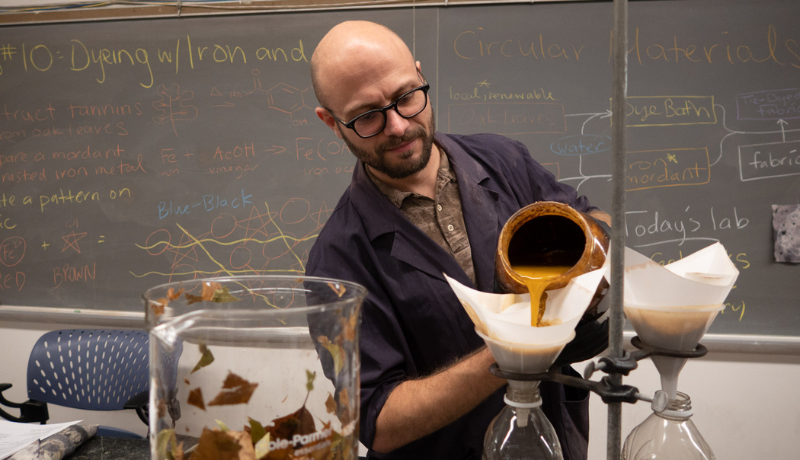
Julian Silverman is an assistant professor in the Department of Science and Math, where he focuses on developing hands-on activities that allow students to learn and practice skills related to chemistry, materials science, and sustainability. His own research focuses on designing functional soft materials from waste-derived matter. And his special workshops at FIT’s annual Sustainability Awareness Week and Sustainable Business and Design Conference are highlights of each event.
This year, Silverman is a research fellow at the Center for Book Arts, exploring the relationship between waste and artist objects. We sat down with him recently to talk about his life at the intersection of science, sustainability, and design.
Newsroom: What brought a polymers chemist to FIT, a college known for art and design?
Julian Silverman: Well, my mother is actually an FIT alum—she went here in the ’80s, studied graphic design—so there was always an awareness of FIT. It had an allure and a certain magnetism. When I found out FIT was looking to fill a materials science faculty position—at the time, I was teaching in the Bronx, at a private college with a cosmetic engineering program—I thought, this is a once-in-a-lifetime. The dream job.
It must have felt amazing to get the job.
I joined the Science and Math faculty here in 2022, and there is something really nice about landing at this place that was part of my family story, but even more it was about what I’d get to work on here: sustainability and materials. Not only cosmetics but fabric, packaging, art supplies—the chance to touch all of it. My research focuses on upcycling waste resources into functional materials, like soap, dyes, or paper. This was such a rare and perfect opportunity to apply that work to real projects.
There are no science majors at FIT. How has the professorial experience been for you?
It was a little scary at first. But when I got here, I realized the beauty of being a professor in a department without majors is that it allows for a lot of creativity. And that’s when I went from being scared to being excited. Liberal Arts and Science classes at FIT are inherently interdisciplinary.
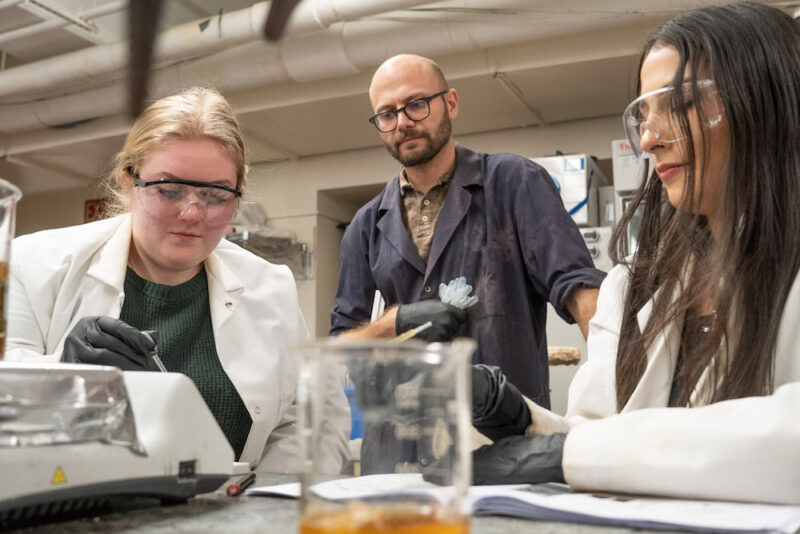
What makes these core curriculum classes so fun here is that the learning happens in context. It’s not plowing through a chemistry textbook, wondering what any of this has to do with your life. All science here is very much applied science, which is very unique. Students learn the material by putting it to use. The class Crime Scene Chemistry is one example of that. Pick Your Poison: Introduction to Materials Toxicology is another. And Chemistry for Cosmetics and Fragrance Marketing.
How do you engage the student who walks into class without much interest in learning chemistry?
A lot of students come to FIT hoping to avoid math and not engage in any kind of science, and what I see is they come into class scared. So my first goal is to help them not be afraid of science. Then I help them recognize the value of what I have to teach them, which they might not see at first.
But questions that routinely come up in their creative work—questions like, “How should I dye this fabric?” and “What fabrics or materials will have the best performance?”—these are science questions. And my role is asking questions that lead and empower them to find the answers. By the time you leave my class, you will know how to find answers. Studying science at FIT, it’s not about becoming a scientist. The goal is for our students to see science as a meaningful part of their creative process and career path.
So we give them tools. Teach them to think in systems, to ask the right questions, to seek answers in the right places. Our students are finding themselves in innovative workplaces—in startups, in textile development—and they are able to participate in science-heavy conversation. They are not the engineers, but they still make a difference because they are able to go to the engineer and ask important questions about, for example, the fibers going into a thread.
How did your Center for Book Arts fellowship come about?
The way it came about started in the lab. Two students and I received a grant to develop paper materials from corn waste that could be used for sustainable packaging. The paper we developed wasn’t durable, not functional for packaging, but it was beautiful. Maybe it could be used to make art. Artist books are works of art in the form of a book. So now I’m involved with the Center for Book Arts investigating ways to make bookbinding more sustainable. Looking at systems of value, consumption, and excess through the lens of bookmaking and learning from the artists.
What’s a piece of advice you often give to students?
Get outside. Change your context. I nudge them to zoom out, take a broader view of things. I make students leave campus, take walks to collect oak leaves and make dye. We have oak trees right here on 27th Street. Go into nature. Awe is the antidote to anxiety.
Lightning Round!
1. What’s your favorite spot on campus?
The library. Especially the fashion forecast service, looking at how 100-year-old trends influence today.
2. If you could learn any skill instantly, what would it be?
Knitting.
3. If you could take a class here, what would it be?
Consumer psychology.
4. What is your go-to outfit?
What I wear is a Brooks Brothers collared shirt and tie with a tie clip. A lab coat. Usually with rolled-up sleeves. Thrifted jeans, black or dark denim.
5. What is one thing about you that students might be surprised to know?
I have a pet rabbit who inspires my work. She is the ultimate sustainable character.