

Rebuilding the creative industries through grit, agile persistence, and the art of negotiation
Nalleli Cobo was 9 years old when she began fighting the urban oil wells poisoning her South Central Los Angeles neighborhood. Growing up in a “sacrifice zone”—where industrial output superseded public health—Cobo spent 16 years challenging the City of Los Angeles and the State of California, a period during which she also navigated a stage II reproductive cancer diagnosis at age 19. But by early 2026, in a 21st-century triumph of David over Goliath, she succeeded at getting the 21 wells at the drilling site in her neighborhood permanently capped and sealed.
Reflecting on that victory last week alongside FIT Sustainability Ambassador Amber Valletta in FIT’s Katie Murphy Amphitheatre, Cobo described her transition from a shy, timid child to a veteran activist as a matter of survival rather than choice. “Fear is temporary,” she told the audience. “Regret is forever.”
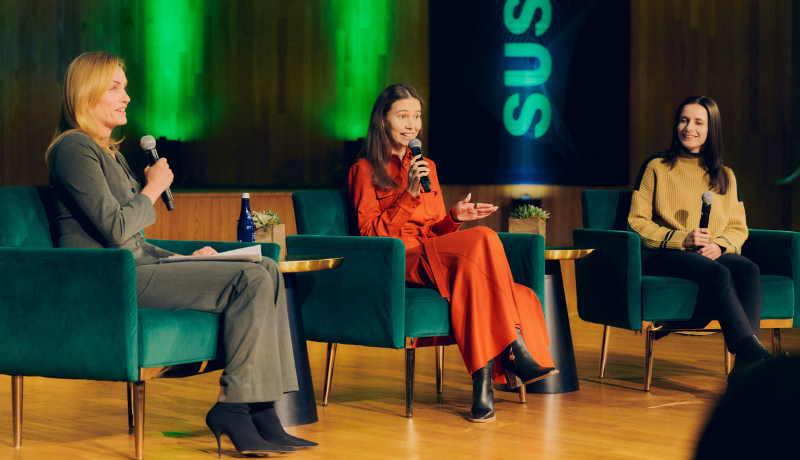
Cobo’s story of grassroots persistence, as an environmental justice activist and Goldman Environmental Prize winner, served as the opening beat of the 20th Annual Sustainable Business and Design Conference at FIT on April 8 and 9. While the event’s theme, Industry Disruptors, promised (and delivered) innovation, the sessions also offered something more grounded: humanity. What follows is a reckoning with the grit, the trade-offs, and the hard-won aha moments required to shift an entire industry away from a broken system and toward a truly sustainable reality.
Strategic Pivoting
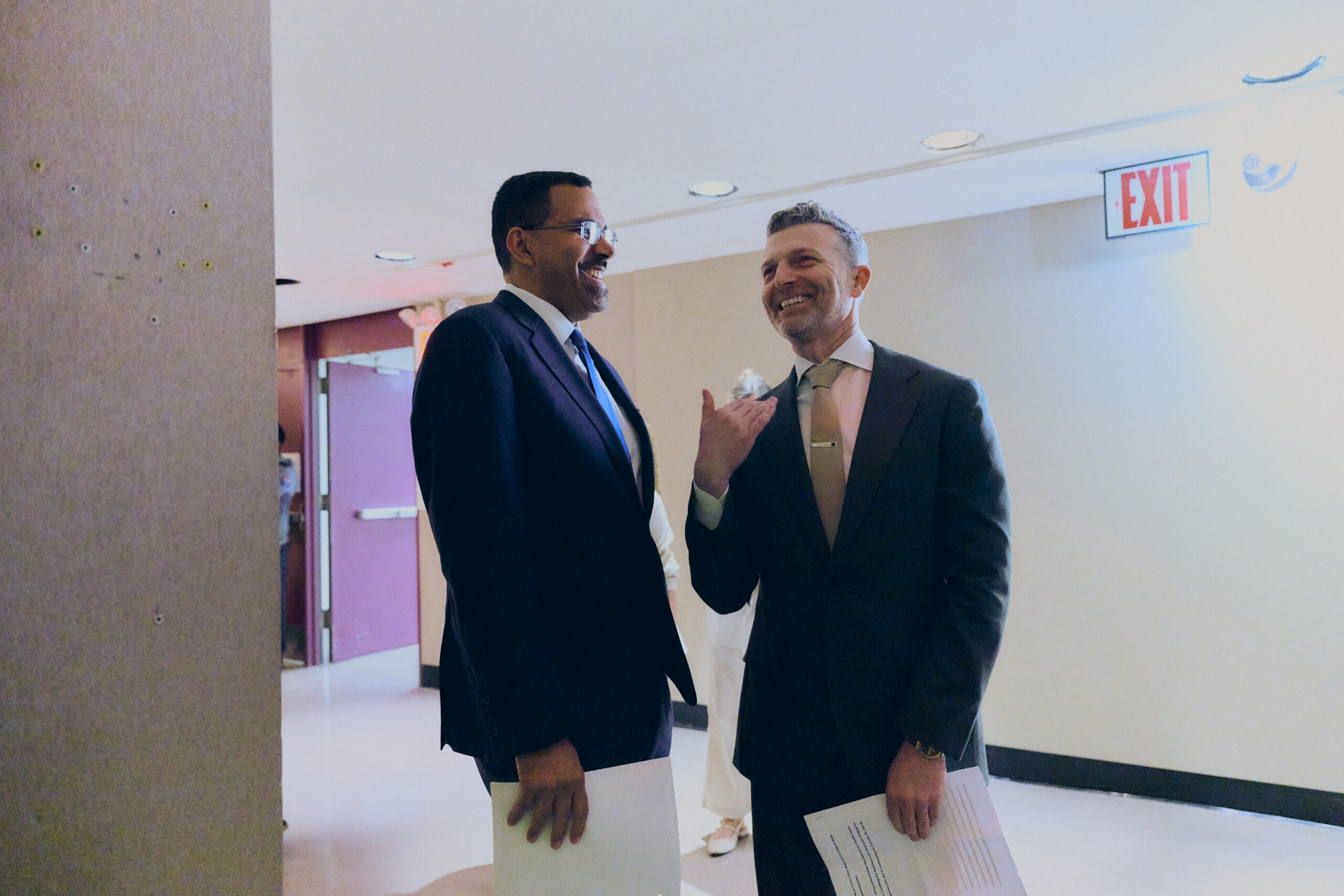
FIT President Jason S. Schupbach and SUNY Chancellor John B. King Jr. connected that individual grit to the college’s broader influence. Schupbach noted that while the industry is only now catching up, FIT’s focus has been consistent for two decades. “Twenty years ago it was not fashionable to talk about sustainability,” he said, “but here it has always been in fashion.” Chancellor King described FIT’s singular focus as “critical” to the state’s climate agenda, framing the college as the blueprint for SUNY’s systemwide plan to reach net-zero emissions. “I want to challenge us to do more, even faster,” he said. “I want to take the lessons from these 20 years of work in the fashion industry and apply them more broadly.”
On stage, those institutional goals met the friction of the marketplace as alumni entrepreneurs described the jump from the classroom to the startup frontlines. Kara Mac, Fashion Design AAS ’85, founding CEO of Kara Mac Shoes, highlighted the friction of ethical manufacturing: “If you are going down the sustainability route, anyone you partner with has to be 300 percent on board or they will try to cut corners,” she said. “You have to stick to your guns and make sure that person who you’re working with understands and supports what you are trying to accomplish.” Deanna Crevecoeur, Production Management BS ’23, who founded ethical handbag company Coeur after the Ethics and Sustainability minor at FIT sparked an interest in regenerative leather, advised future startup founders to pivot quickly from research to action: “Learn by doing,” she said. “Be well researched but don’t take too much time researching. Just get your product out there to potential customers.” Michael Ferraro, executive director of the FIT DTech Lab, provided the baseline for startup survival: “Being agile is the single most important thing in being an entrepreneur.”
The Price of Principles
Agility isn’t just a mindset; it’s a tool for forcing systemic change. In that first session, moderated by Valletta, inventor Noemi Florea described how her academic project evolved into Cycleau, a water-decontamination venture. “Make what you’re working on in class become the project that’s worth building,” she told the students in the audience. “Keep refining that will take you to a level where you get funding … You don’t have to join corporate America and lose your values. You can take your idea and start your own business that is your full-time job.” Florea, 2025 U.N. Environment Programme Young Champions of the Earth award winner, also noted that new technologies often act as the catalyst for systemic change, forcing the creation of the regulations needed for a better system. “Innovation and policy have to work in tandem for system change. Innovation can shift policies because they make technologies for change exist.”
The conversation turned to the economic reality of integrity, on day two of the conference, when Mulberry CEO Andrea Baldo took the stage for a transparent assessment of the British lifestyle brand’s 55-year legacy. Discussing Mulberry’s “Made to Last” manifesto, Baldo admitted that sustainability requires sacrificing immediate profit to honor materials and craftsmanship. Responding to the audience question—“Do you have to give up profit to be sustainable?”—Baldo didn’t miss a beat: “Absolutely!” he said with remarkable candor. “Sustainability is expensive. Consumers need to buy into this. We pay a living wage, not minimum wage. A living animal lost its life to give us this leather, so we better be doing the maximum we can to use it.”


The responsibility of use—and the staggering weight of its alternative—was underscored by Fashion Design Assistant Professor Andrea Diodati. Moderating a session on extending products’ lifecycle via upcycling, mending, and repair, she offered a sobering metric for the room: “Six million garments will be made by the end of this panel,” she said. “This is the scale of this industry’s overproduction.” Rather than retreating into paralysis, zero-waste designer Janelle Abbott and mending-maven Kate Sekules encouraged the audience to focus on changing their own consumption habits. “Every day my mission is to reclaim as much material as possible,” Abbott said, adding that she champions maximalism as a form of upcycling, while Sekules urged a return to mending, where visible repairs act as a wordless announcement that a garment is worth saving. “What you’re doing visually is not only fixing in a way that pleases you,” Sekules said, “you’re making a statement that you’re not throwing this away, making a statement for sustainability just by walking around.”
The End of More
The final afternoon turned toward the resale economy and the necessity of legislative pressure in a panel moderated by FIT Foundation Board chair Doug Hand who also sits on the board of Goodwill. The conversation shifted to the stark reality of the waste stream when Samantha Rich, NY/NJ Goodwill’s executive vice president of Donated Goods Retail, and Sarah Davis, founder and president of Fashionphile and also a member of the Foundation board, called out the current system that lets brands profit from production while leaving the cleanup to everyone else. Rich noted that Goodwill is now lobbying for laws that address the problem at the factory level, rather than at the donation bin, while Davis suggested that if brands united, they could certainly solve these supply chain issues almost overnight.
 This global footprint was illustrated by filmmaker Dr. Nate Dappen and designer Frederick Anderson, who discussed the mounds of discarded clothing in Chile that have replaced traditional manufacturing. Dappen argued that personal choice is often an illusion used by corporations to offload responsibility. “The only way to stop it,” he suggested, “is to make a rule, a law saying you cannot do this anymore.”
The conference concluded with a keynote from Stacy Flynn, Textile Development and Marketing ’99, co-founder of Evrnu, who reflected on her own role in creating industrial waste before challenging the students to use their technical skills for more than just production. “You are not here to make more shit,” she said. “You are here to create. But are you creating hell on earth or something different?” But while her warning was blunt, she ended with a vision of radical possibility. She urged the room to see themselves as the architects of a new system, one where every design choice actually repairs the planet. “Can you imagine a world,” she asked, “in which everything you create upholds the world? That, my friends, is how fashion wins the war on waste.”