
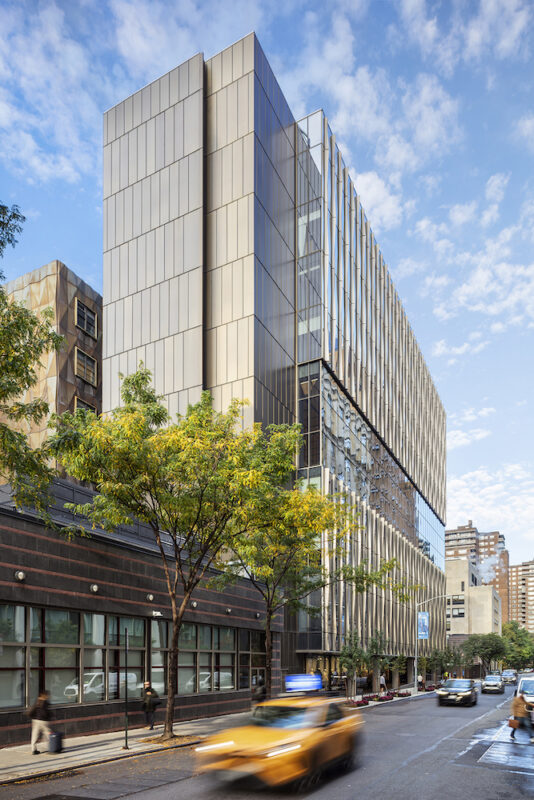
 On April 23, Sherry Brabham, vice president for Finance and Administration, announced that the Joyce F. Brown Academic Building has earned LEED Gold certification for sustainability.
The LEED certification program, created and administered by the U.S. Green Building Council, is the preeminent sustainability rating system for buildings in the U.S., if not the world. Buildings can receive Platinum, Gold, Silver, or Certified designations based on a point system. This LEED certification is the second one for FIT: The renovation that created the state-of-the-art Dubinsky Labs, completed in 2010, achieved LEED Silver.
The building, known as the JFB, scored particularly well for its location, energy usage, indoor environmental quality, and innovative design. Sustainable features include:
- Located in the heart of New York City, the JFB has easy access to multiple subway lines.
- The building is energy-efficient, not just in its state-of-the-art heating, cooling, and ventilation systems, but also in their management.
- The materials selected, such as polished concrete floors and low-VOC paints, are sustainable and nontoxic. Restroom fixtures reduce water consumption.
- The indoor air quality, temperature, and lighting enhance the comfort of the interiors. Large windows looking out on West 28th Street provide an open and airy atmosphere.
- Solar panels on the roof offset some of the building’s energy usage.
LEED’s documentation process is exacting and comprehensive, Brabham explains, and it required collaboration among FIT; SHoP Architects, the building’s designers; and Buro Happold, an engineering firm contracted by SHoP.
She says that the sustainability of the building is important not just because it makes the building more comfortable but also because it aligns with the college’s sustainability mission, the curriculum, and student demand.
“Sustainability permeates as a value for the college,” she says, “not just operationally but also in the education process.”
Bill Sharples, the architect at SHoP who headed up the project, is proud of the building’s energy efficiency. But for him, the most sustainable aspect of the project came from site-selection. The building is interconnected with the other academic buildings, allowing students to attend all their classes without needing to leave the campus.
“We took the most underutilized piece of the campus,” he says, “and made it incredibly valuable.”
Michael Woods, a LEED-accredited architect who teaches FIT’s Interior Design class Materials in a Sustainably Built Environment, emphasizes the importance of sustainable buildings, as they make up 40% of worldwide carbon emissions.
“In New York City, we live with our buildings for a very long time,” he says, “so we want to make them as energy-efficient as possible.”