
Newsroom: Your career reads like a series of distinct, deliberate chapters—from an English degree at Oberlin to leadership at the Rainbow Heights Club, through clinical training at Hunter, and now to FIT. There’s a clear thread of identity and storytelling woven through it. How would you describe the arc of that journey?
Rebecca Hoffman: After college, I was working at an organization advocating for food security and affordable housing while teaching English composition at Brooklyn College. And I realized I was at a crossroads, like in the Robert Frost poem “The Road Not Taken.” Would I pursue a PhD in English literature or carry on with social services? I made the practical decision to take the road more traveled, the one that would lead to health insurance and traditional benefits. I chose social work, earning an MSW instead of the PhD. But literature is a big part of my practice. Bibliotherapy. I often recommend books to my patients. Seeing mirrors of ourselves and our struggles in stories is so important.
Before coming here, I was program director of the Rainbow Club in Brooklyn for seven years, a space for LGBTQ+ folks living with serious mental illness, and later worked with people in the New York City homelessness shelter system. These roles involved helping people in very desperate circumstances with access to few resources. My work here, on the other hand, is hopeful and joyful—these are young motivated people who are in school—and FIT has so many rich resources available to help them. But, the common thread, everywhere I work, is that people are people and everybody needs a listening ear.
What’s your typical day like at FIT?
I have assessments with first-time visitors, follow-up appointments, and individual sessions. We encourage people to come see us before things are dire, but emergencies happen. We might have a walk-in in a critical situation who we screen immediately to make sure they’re safe. As a college center, ours is a short-term model. A big part of what I do is provide support and connect students with the right longer-term care, matching things up with their insurance or affordable providers. Some days I’ll do a group. You might find us in the lobby doing something fun. Students love to make slime; it’s super nostalgic, tactile, and relaxing.
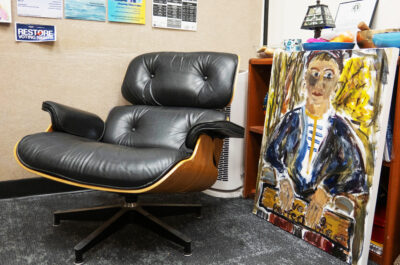
The couch is a classic therapist trope: Is there one in your office?
Almost. I have an Eames Lounge Chair. It’s comfortable and relaxing, and the design students love it!
The group you lead has such a refreshing, joyful name: Gender Identity Is Fun!
I wanted to create a fun space where people can be themselves. They say this school is a haven for LGBTQ+ in general, but it’s nice to have a special space that is more specific. The gender nonconforming group is uniquely challenged, and I feel like trans and nonbinary folks need some extra TLC. We get together, we do art—there are so many artistic people here—and we relax. Sometimes people want to talk about heavy stuff. Sometimes they just want to have fun, share stories, and swap notes on things like transitioning.
Headlines often suggest Gen Z is in a unique state of crisis. What’s your boots-on-the-ground perspective?
I am struck by the insights and compassion these students have, the broadmindedness. They’re facing very difficult circumstances, but it’s not them who are in a state of crisis: It’s the economy. The last upwardly mobile generation was their grandparents’, and here they are, pouring themselves into creatively preparing for a job in the arts, and they’re asking: “What does it mean to pursue my future in these economic conditions?” Given what they have on their shoulders, they are pretty cool. They’re taking care of themselves and figuring out how to prepare.
How do you help students honor the struggle and uncertainty of late adolescence—without pathologizing normal growing pains?
Young people need to be heard, to disclose their burdens: challenges at home, exhaustion from carrying too many courses, financial stress. When we honor what they’re going through and tell them, “You feel overwhelmed because your circumstances ARE overwhelming,” it’s a load off. To see them walk out with that weight lifted off their shoulders feels incredible.
Competition and pressure can run high at FIT. How do you help students decouple their self-worth from their latest studio critique?
In my office, there is no classroom pressure. When someone says, “I feel so behind my classmates, they’ve been sewing since they were six,” we can get real: In everyone’s life, there’s always somebody who seems better. But I say, “You’re such a wonderful person and I want to help you enjoy being you. Let’s figure out how to take some of this pressure off, so you can enjoy being you.”
In your own young adulthood, did a mentor help you find your way?
The counseling office at Oberlin made an enormous difference in my life. My counselor there helped me settle down—I was dealing with some neurodivergence, undiagnosed and untreated—so I could stop feeling guilty about having a hard time and start being successful at school. I learned lessons from that counselor that shaped my whole career. From that experience, I understand how important college counseling is and I’m especially happy to do it here at FIT. It’s a privilege to be involved with people who are passionate about human creativity and self expression. Art, culture, and handcraft are among our greatest human accomplishments and our students are holding the skills to keep them alive.

If college-age Rebecca met counselor Rebecca today, what’s one thing you’d tell her?
Go easy on yourself. This is my self-portrait, Recovering Perfectionist (at left). I am only able to help others if I’m gentle with myself. My main message to students is, be gentle with yourself. In granting ourselves grace, we make the world a safe place for ourselves and others.
What essentials are in your mental-health toolkit?
I try to practice what I preach: Sleep well, get sunlight, eat things you like and also healthfully, take breaks. But honestly, my best antidote for anxiety is doing work that helps: getting involved instead of spinning wheels.
Lightning Round!
1. How do you reset on a hectic day? I will tell you my secret: There’s a pocket park on Tenth and 28th. I go over there, take a spin around the astroturf.
2. What one skill would you like to download from an FIT student’s brain? Artistic ability, the drawing and painting skills.
3. What defines the Rebecca Hoffman style? Cords! I’m always in cords. My staff used to always say they could hear me coming: zzzzzoop zzzoop zzzzooop.
4. What’s one thing about you that students might be surprised to learn? I lived in a tent one whole summer.
5. This-or-Thats: Coffee or tea? Both! Coffee in the morning, tea in the afternoon. Sweet or salty? Sweet. Window seat or aisle? Window, 100 percent.
6. If you could install a mental-wellness vending machine on campus, what would it dispense for free? Time!