
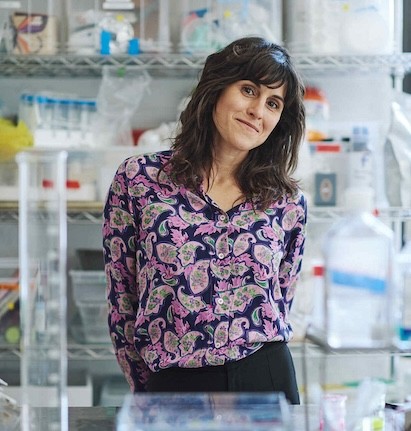
 FIT, in partnership with Columbia University, has been awarded an $11.5 million grant from the Bezos Earth Fund to develop a high-performance, sustainable textile fiber grown by bacteria. We asked professor of Science Theanne Schiros, the FIT lead on the grant, about the project.
“Our main goal is to use bacteria and agricultural waste to produce a replacement for polyester,” Schiros says. The fibers, while matching the strength and stretch of synthetics, would require no land, produce no microplastic pollution, and be backyard compostable.
Schiros is co-leading the work alongside Helen Lu, a biomedical engineering professor at Columbia, as well as a host of FIT faculty, bringing together biology, materials science, machine learning, and design.
The project is dubbed PRISM (precision, regenerative, intelligent, scalable materials). Over five years, Lu’s team will first develop an AI model to map how growing conditions for bacterial cellulose affect the fiber’s growth, strength, and performance, allowing the researchers to precisely engineer fibers with specific properties. During the growing process, the bacteria will feed on agricultural waste (such as spent grains from breweries or leftover mash from distilleries), further reducing the fiber’s ecological impact. Researchers will also use muslin scraps left over by FIT Fashion Design classes as bacterial feedstock, allowing for textile-to-textile recycling.
Finally, the FIT team will use data from across the project to develop an advanced life-cycle assessment (LCA) framework for bioengineered fabrics. An LCA is a standardized way to measure the environmental impact of a product from its creation to the moment the consumer throws it out; for bioengineered fabrics, having a rigorous and transparent LCA is needed to make credible sustainability claims.
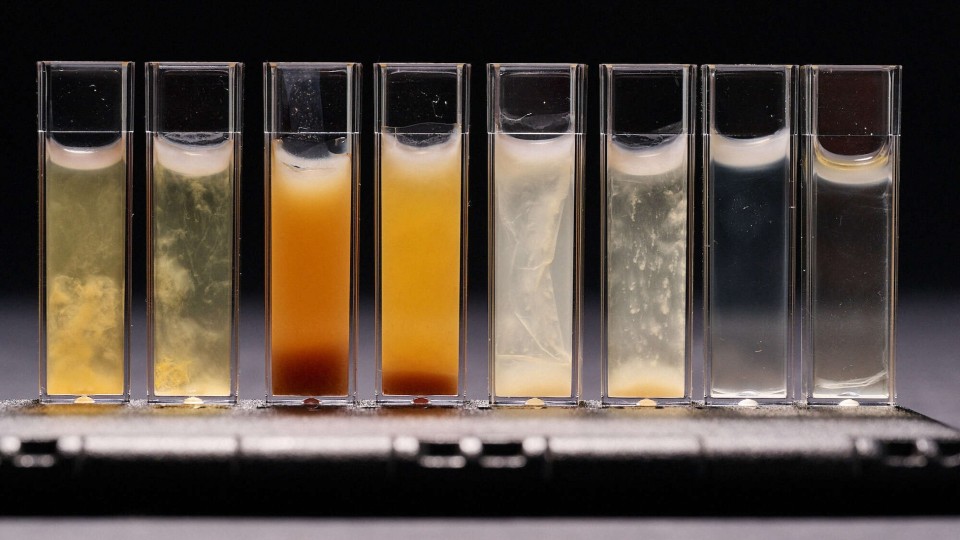
Recent years have seen major advances in bioengineered fibers—notably, by FIT student teams competing in the Biodesign Challenge and by Schiros herself, whose alternative-leather sneakers recently joined the permanent collection of National Geographic’s new Museum of Exploration. But standardization and precision remain major hurdles to large-scale production.
“If you’ve ever tried to grow a houseplant, you understand the fundamental heterogeneity of biology and building with biology,” Schiros says. “We don’t have the precision of synthetic chemistry, which is super uniform.”
So how close are we to seeing bio-based fabric in stores? Not very. She notes that any commercial bio-based fabric would need to have exceptional performance to dislodge modern synthetics, which are cheap and ubiquitous. “You can’t just make a more sustainable material; it has to be so good that it completely outperforms the alternatives,” she says.
FIT students can participate at all stages of the process as research assistants, including working on data analysis, developing fibers into yarns, prototyping knits, and hosting symposia for stakeholders in the biotextile space. Other FIT faculty on the research team include Ann Cantrell, associate professor of Fashion Business Management; Calvin Williamson, professor of Mathematics; Asta Skocir, professor of Fashion Design, and Amy Sperber, assistant professor of Fashion Design. From Columbia, the PRISM team includes Marianna Maiaru, associate professor of civil engineering and engineering mechanics; Mary Boyce, professor of mechanical engineering; Harris Wang, professor of systems biology, of pathology and cell biology, and of biomedical engineering. And from Michigan Technological University, Gregory Odegard, professor of computational mechanics, mechanical and aerospace engineering.