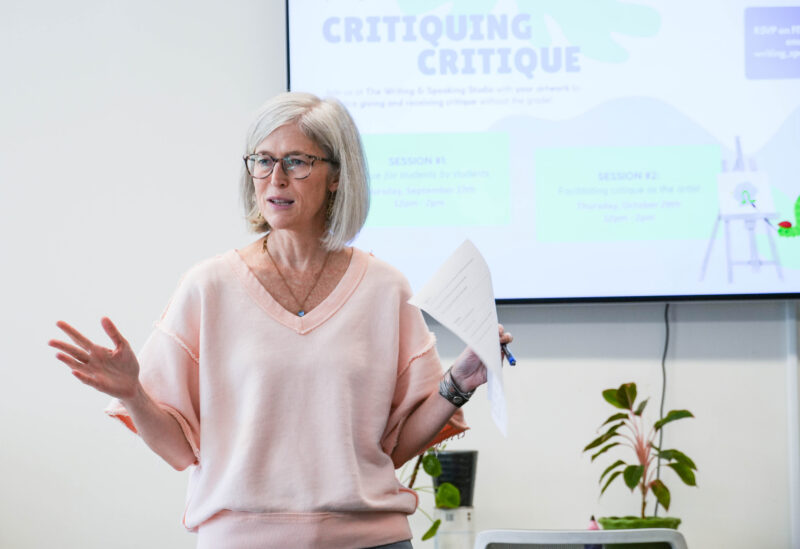
The FIT Writing and Speaking Studio offers one-on-one and group sessions for students, faculty, and staff, under the leadership of Director Sarah Blazer. Here, Blazer talks about the magic of peer tutoring, unlearning linguistic bias, and why the “productive struggle” of creating matters in the age of AI.
Newsroom: Why is it worthwhile for all FIT students to develop their writing and speaking skills?
Sarah Blazer: Writing and speaking are tools of self-discovery that help you think and find your footing, your voice, and your style. To deepen your practice and skill, and to gain opportunities, scholarships, or prizes, you must communicate with audiences about your work.
A distinguishing feature of the studio is its peer-tutoring model. What are the advantages of that student-led approach?
Something magical occurs when peers work with one another in the studio because they figure things out together. When students are encouraged to lock into their “peerness,” the equality and mutuality of their connection levels the playing field and creates a nonjudgmental, less self-conscious space for developing ideas.
Why is the peer model so effective at FIT where technical skills and creative expression overlap?
FIT students do such unique work. Students who come in for tutoring often work with peer consultants who are not in their major—this allows them to leave their academic silo while still collaborating with another creative person. That mix of perspectives and energies is key here.
You encourage peer consultants to pitch new programs. What are some recent highlights?
We are always doing new things, which is fun. FIT Lingo is a great example. This series was created entirely by a couple of peer consultants who love language and wanted to bring people together to learn without pressure, showcase their multilingual backgrounds, and connect. Other popular peer-consultant-created workshops have been comics writing and digital portfolios.
At a globally minded school like FIT, how do you reframe English as a second language as a creative asset rather than a hurdle?
Multilingualism adds to an individual’s rich repertoire. It’s a gift we want to celebrate. People with linguistic versatility are positioned to reach farther and wider with their art, product or business ideas, or whatever they do.
Even our peer consultants haven’t always felt confident about their own diverse language backgrounds. Many have been conditioned to think about their English as “less than” because they’ve been told there is only one right way to do this. Training our consultants means helping them unlearn that conditioning first.
How do you train peer consultants to be nonjudgmental while providing the feedback necessary for academic growth?
Once they connect with the value of their own voice, our peer consultants can guide others to do the same. We train them to invite students into a collaborative conversation, rather than acting as gatekeepers of “correctness.” That is how you offer critical, academic feedback without judgment—by treating the student as a decision-maker who is navigating rigid institutional expectations with awareness.
Lightning Round!
1. How do you make the studio inviting? Snacks!
2. One piece of advice for students? Don’t let technology steal your right to learn and create and struggle. Losing that productive struggle is what worries me most about habitual use of AI chatbots for writing and research; I’m concerned about AI depriving us of the satisfaction of figuring something out.
3. One book you’d like to give everyone at FIT? Tomorrow, and Tomorrow, and Tomorrow [by Gabrielle Zevin]. It’s a very complex story about video game designers navigating their beautiful and deep but fraught relationships over decades. Their intense creative processes are a big part of the story, and even though I don’t play video games, I loved every detail.
4. You obviously think a lot about writing style. How about your personal style? Corduroy in the fall and winter—and a blazer any time of year!