
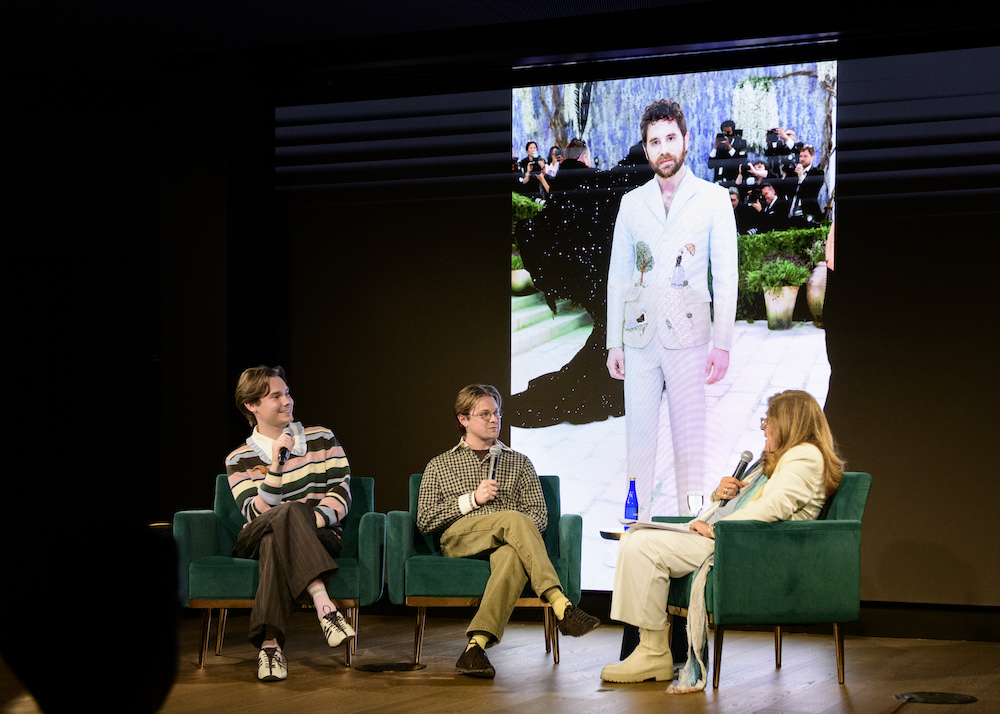
Tanner Richie and Fletcher Kasell founded their label Tanner Fletcher in 2020, inspired by their Midwest upbringing, love of Americana, and exuberant love for one another. “We like to put our customers out of the box rather than put them in one,” Kasell said of their genderless, idiosyncratic styles. They take the same approach to their business.
Richie and Kasell joined Fern Mallis, author, co-creator of New York Fashion Week, and board member of the FIT Foundation, for the Future//Forward Innovation Speaker Series on November 3. They talked about their unconventional path, being romantic and business partners, and building a brand and creative practice—largely by breaking all the rules.
The two met during a college roommate search at the University of Minnesota. They fell in love, moved in together, and eventually headed to New York City their junior year to study fashion merchandising. Tanner Fletcher started as a pandemic project.
“We didn’t really know anything about starting a business,” Kasell admitted. “We also didn’t really know anything about design because neither of us had training in design. … We had to figure it out—we didn’t have a choice.”


In the beginning, the pair funded their brand by scouring secondhand stores for designer clothes to sell on sites like Depop and Poshmark. They used those earnings on fabrics and materials for their samples, though the treasures they found ended up inspiring them too. “We kind of formed a [mental] archive while we were shopping for all these things,” Kassel said.
Their first investment: hiring a PR agency, which got them on the CFDA Fashion Calendar, and led them to Mallis, who became a supporter and mentor. “We didn’t know anybody in the fashion industry,” Richie said. “We’re not going to just make a collection for nobody to see.” Their biggest break was in 2023, when Bad Bunny wore one of their bow-embellished suits on the cover of Time magazine. “That was a real pinch-me moment,” Richie said.
Tanner Fletcher has since expanded their team and offerings. They sell antique home goods alongside their original designs and have a booming made-to-order wedding category, which accounts for 50 percent of their direct-to-consumer business. They advised the students in the audience to, above all else, stay true to themselves.
“I feel like anybody in fashion school has a vision, and I think you need to keep that close to you and stay confident about it,” Kassel said. “Even if you’re not starting a brand or you’re not a designer, you should still have your own internal brand and make decisions based on that brand.” —Raquel Laneri
Read Newsroom’s coverage of all of the FIT Future//Forward Conversations.