
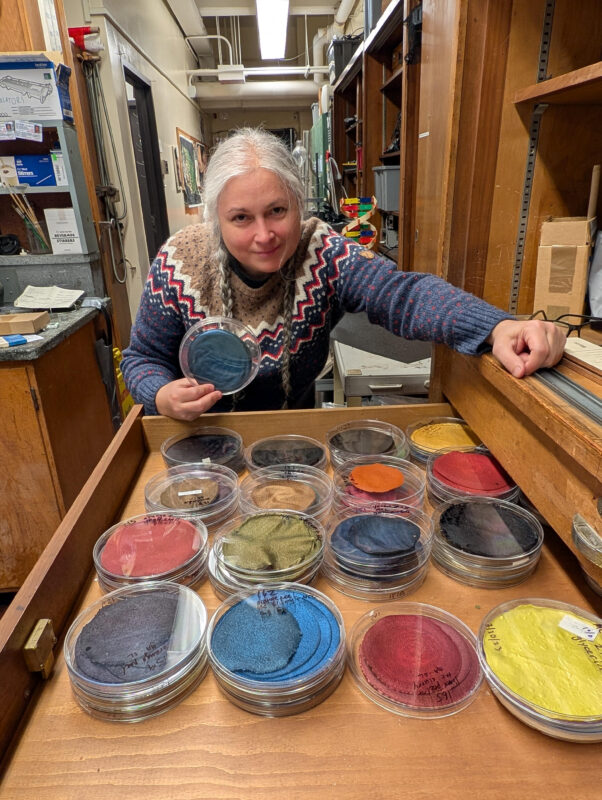
From 60,000-year-old Neanderthal “super-glue” to WWII-era milk-spun fabric, humans have always found ways to forge useful materials from whatever is on hand. Today, in Room C806 of the Feldman Center, FIT researcher Gwen Sanchirico is carrying that spirit of innovation into the future.
Tucked away in her lab drawers are samples of mango-pulp bioleather that smell good enough to eat (though you shouldn’t) and a growing collection of novel biomaterials ready for your next project.
A technologist in the Science and Math Department, Sanchirico is bridging the gap between ancient adhesives and modern plant-based leathers. From her perch on the eighth floor, this “biomaterials maven” is building the college’s first Biomaterials Reference Library from the ground up. The collection features neatly housed petri dishes of vibrant samples—each developed from salvaged rubbish, such as orange peels, eggshells, and spent tea leaves, alongside mushroom powders and kombucha cellulose. You’ll even find functional items, like wallets and coin purses, fashioned from these circular composites.
Fueled by a recent sustainability grant, the library is an archive designed to help students and faculty swap unsustainable materials with planet-friendly alternatives. “We would love for more people to stop by, have a hands-on experience, and get inspired,” Sanchirico says.
From her hub in C806, Sanchirico invites the campus community to touch, smell, and study circular material science and waste-based innovation. With samples ranging from agar bioplastics to fish-skin textiles, the library is a living project that proves, with a little human ingenuity, trash can be transformed into truly functional regenerative materials.
Ready to explore? Students and faculty can email Gwen Sanchirico in the Department of Science and Math to schedule a hands-on session.