
Two of the most significant menswear looks from the past 250 years are attributable to George Washington. So says Chloe Chapin, Fashion and Textile Studies: History, Theory, Museum Practice MA ’15 in an audacious new article for the Transactions of the American Philosophical Society. Chapin earned an MFA in Costume Design from Yale School of Drama, and worked as a costume designer for Broadway musicals and opera while teaching fashion history at FIT (2006–14). She received a PhD in American Studies from Harvard in 2023. Her first book, Suitable: The Sartorial Revolution and the Fashioning of Modern Men (Oxford University Press), published in June, has received favorable reviews in Harper’s Magazine and Lit Hub, among others. We sat down to discuss the founding father of American men’s fashion.
Newsroom: In your article, you write, “two of the most widespread masculine fashions since the birth of America are inspired by George Washington.” Which looks?
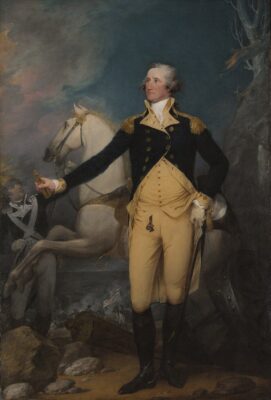
Chapin: The first is “buff and blue,” which we see today in navy blazers and khaki pants. Washington designed his own buff and blue uniform in 1774 for the Fairfax County Independent Company, a local Virginia volunteer militia, and then he kept wearing that uniform during the Revolutionary War. Even then, men adopted buff and blue as civilian dress, specifically in support of Washington. The second style is plain black suits.
This is a really bold idea—a revision of conventional fashion history. Typically, we hear that American style follows Europe. You even argue that renowned dandy Beau Brummell (1778–1840) was influenced by Washington. Is the fashion of American men underestimated?
You know, I really think it is, and I honestly wasn’t expecting that. Another one of those funny “that doesn’t make any sense” moments came from teaching one of those big fashion history survey courses at FIT for nearly a decade. The courses are essentially the history of the richest people in the world at any given time period. The focus is heavily on England and France until the 1930s and the Hollywood Golden Age. But in the second half of the 19th century, the American East Coast robber barons were some of the richest men in the world! It was surprising that fashion history hadn’t previously paid much attention to what they wore. And then in my book research, I found that some of the key ideas of modern men’s dress were really championed first by the Founding Fathers specifically as a way to articulate what they saw as the American character, which of course was a brand new invention at the time.
What were some of your sources for the research?
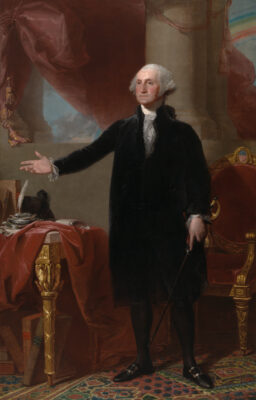
Doing research on black suits was really tricky. You don’t see a lot of black suits in fashion plates, for instance, because why bother advertising a plain black suit—but then they’re everywhere in paintings. I found compelling evidence in the New York City Hall portrait collection; after filtering for the first half of the 19th century and removing military uniforms, every single politician was dressed in a black suit. One other relatable discovery was George Washington’s letters to his London tailor complaining that his pants never fit; he essentially had a wedgie for 10 years because he insisted on using an overseas tailor.
You mentioned he purchased crimson broadcloth and wore velvet. We don’t usually picture him in such extravagant clothes.
Most images of Washington show him dressed in a military uniform or black velvet suit. But he wore a purple silk suit for his inaugural ball, and a brown wool suit for his inauguration. People often call it “plain,” but brown was very fashionable then. Also, Washington didn’t care what color it was, he just cared that it was the highest quality wool America could produce.
You wrote that “there is a whole material language of American democracy that remains to be translated.” What do you mean by that?
I’m calling attention to how overlooked fashion has been in traditional studies of America’s past. Fashion history is often siloed in museums or design training programs—but not included in academic departments in the humanities or social sciences.
I was excited to publish this article in Transactions—the oldest scholarly publication in the U.S., started by Benjamin Franklin!—so that I could speak to American historians about dress in a language they would understand. By calling George Washington a “fashion icon,” not only am I challenging the idea that our political heroes weren’t fashionable, I’m also challenging the way that fashion has been undervalued within academic discourse.

