
 In most creative academic environments, educators evaluate a student’s process and final project to gauge understanding of the concepts taught. Generative AI has upended this, letting anyone produce good enough–looking work instantly—often without the iterative, human-driven processes those outcomes are meant to reflect.
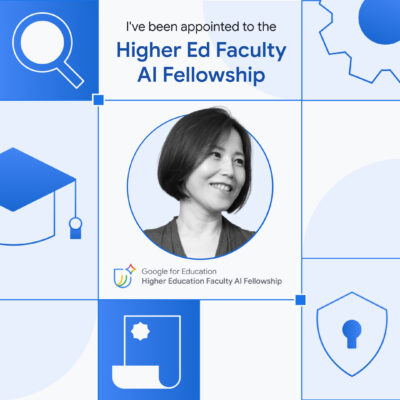
Christie Shin, professor of Creative Technology and Design, has been wrestling with how to evaluate the AI-assisted projects she assigns. She applied for a new fellowship from Google with the goal of addressing this quandary. This spring, she was named a Google Higher Ed Faculty AI Fellow, joining an inaugural cohort of 65 North American educators tackling AI-related challenges in the classroom.
The cohort meets virtually three times this summer before a two-day conference at Google’s Mountain View, Calif., headquarters in September, with smaller groups meeting more frequently.

“Working inside the Google ecosystem will let me stress-test what I am building in the classroom against what actually is happening at the frontier of the industry,” she says.
In the classes Shin teaches, she requires students to document their creative process, reflecting on AI’s role and on how their individual experience and background shaped the work. Google’s fellowship will help her formalize and scale this process.
“I want to bring back frameworks and tools that faculty across all disciplines can use, and for FIT to be a blueprint that other institutions can use and point to,” she says.
“Being selected for the fellowship means Google sees what I see and these challenges are significant enough to demand systemic solutions, not quick fixes,” she adds. —Irina Ivanova