
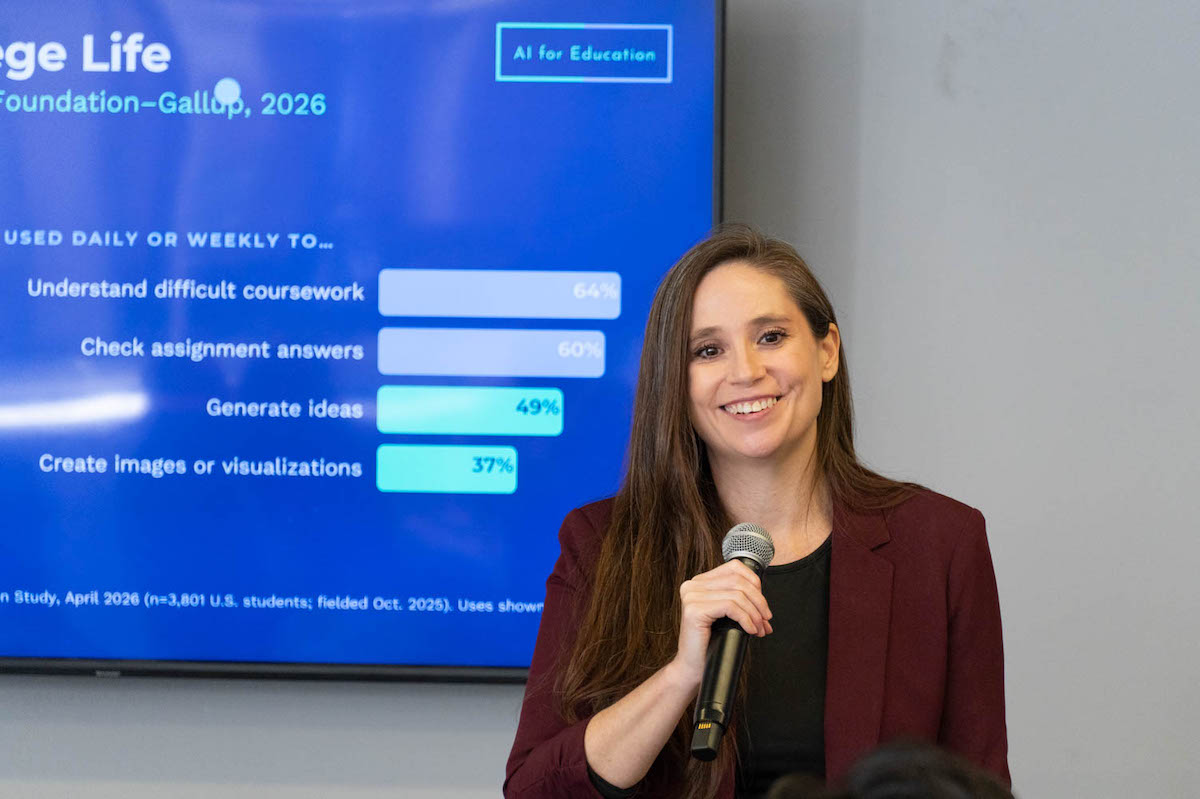
On Monday, November 9, FIT’s Jay and Patty Baker School of Business and Technology hosted an AI Summit, exploring how AI is changing teaching and learning in higher ed.
“Most students are on their own,” said keynote speaker Amanda Bickerstaff, co-founder and CEO of AI for Education, and a leading advocate for the responsible adoption of AI in education. “An 18-year-old walking into your classroom has not had any AI literacy training. They’re coming in with a lot of usage, but usage does not equal knowledge.”
Bickerstaff’s presentation, “AI Literacy: Preparing for an AI-Integrated Creative and Business Landscape,” challenged FIT educators to look beyond students’ familiarity with AI tools and to consider whether they truly understand how to use them.
That distinction, she argued, makes the role of educators more important than ever. Rather than simply warning students against AI, faculty need to create environments where students feel comfortable discussing how they use it.
“If you create a safe space in your classrooms, they’ll be honest about their usage,” she said.


One of the reasons it is so important in the creative industries to “remain human” is that there is no right or wrong for taste, there is no right or wrong for trends, and you can do market research, but everyone is always surprised at what really “catches fire.”
We are also seeing a gender gap, Bickerstaff said. Men are using generative AI across every industry more, in everything from tech to business to retail. Fewer women have access to training and no one has shown them the way, so they feel that it’s like cheating.
Taste, trends and cultural relevance cannot be reduced to data or reliably predicted by market research, she said in conclusion. What ultimately catches on can still surprise everyone. That uncertainty is part of what makes human creativity indispensable.
Afterward, Kristy Fall, assistant professor, Marketing Communications, and Bridget Lavery-Palmieri, assistant professor, Fashion Business Management, shared takeaways from the recent American Association of Colleges and Universities Conference on AI and Higher Education.
They shared one central message: As AI takes on more tasks, colleges must place greater emphasis on the human capabilities that technology cannot replace, particularly judgment and critical thinking.
That means assessing the learning process, not just the final product. Assignments should incorporate productive friction—opportunities for students to work through challenges, demonstrate their thinking and build skills rather than simply submit polished results. Simulations and AI-enabled tools can help make that thinking visible.
The faculty members also emphasized the importance of working with industry partners to co-design curricula that reflect changing workplace expectations.
In other words, AI is changing education, but it will require a concerted effort from all of FIT to ensure it changes for the better.